Hand-Crank vs Electric Drum Carder: Which One Is Right for You?
Hand-crank carders are simple, quiet and affordable. Electric carders free both hands and spare your joints. We compare cost, speed, control and comfort so you can decide.
The Workshop Team
Wool Drum Carder · October 5, 2026
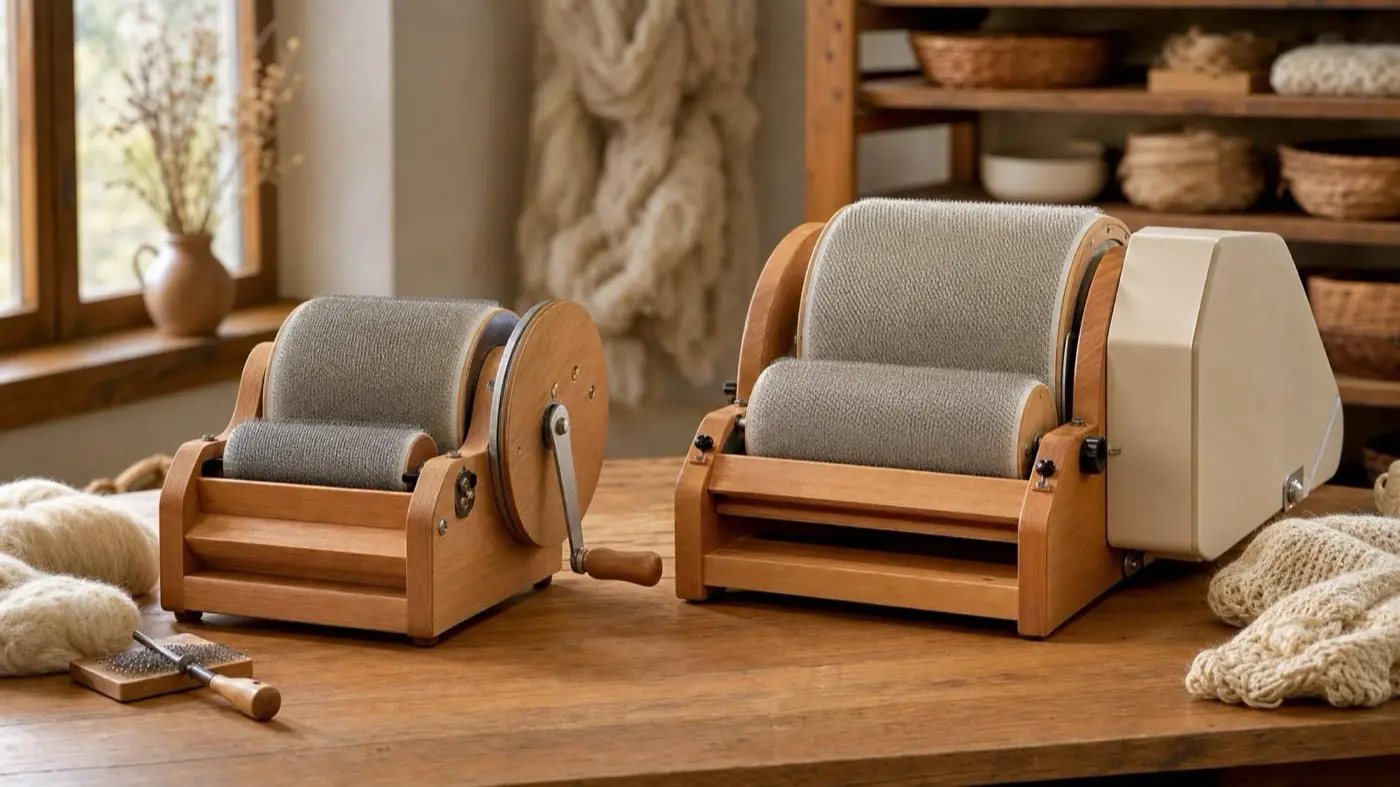
A hand-crank drum carder and an electric drum carder side by side on a workshop bench
Both hand-crank and electric drum carders produce the same kind of batt. The cloth, drums and carding process are the same. The difference is who turns the drums: your arm, or a motor. That choice affects comfort, speed and price far more than batt quality.
1. The case for hand-crank
Hand-crank carders cost less, have fewer parts and need no power, so they work anywhere: at a guild meeting, at a fiber festival or outdoors. Many spinners enjoy the rhythm of cranking and the direct feel for how the fiber is moving.
Cranking with one hand while feeding with the other takes a little practice, but most people get comfortable within a few batts. For someone carding a few batts a week, a hand-crank carder is often all they need.
2. The case for electric
An electric carder turns the drums for you, so you can feed and guide fiber with both hands. That usually means more even feeding and faster, more consistent batts.
Variable speed lets you slow down for delicate fiber and speed up for sturdy wool. A foot pedal starts and stops the drums hands-free, and a reverse function makes clearing a wrap on the licker-in quick and easy.
“If cranking causes wrist, elbow or shoulder pain, an electric carder is often the difference between carding and not carding.”
3. Volume and business use
If you sell batts, run a small farm, or process several fleeces a season, an electric carder pays back its cost in time saved. Long carding sessions are much less tiring when you do not have to crank.
For farm-scale volumes, a wide electric carder such as the Mill 16″ Electric Drum Carder produces batts of up to 100 g per pass.
4. Noise, space and power
A good electric carder is quiet, but it still has a motor, a power cable and a pedal. Make sure your workspace has a nearby outlet and room for the pedal.
Hand-crank carders are silent and fully portable. If you travel to classes or festivals, a compact hand-crank model like the Traveler 6″ Small Drum Carder is hard to beat.
Key Takeaways
- Batt quality is the same; the difference is comfort, speed and price.
- Choose hand-crank for portability, simplicity and lower cost.
- Choose electric for long sessions, joint comfort, selling batts or farm-scale volume.
- Variable speed, a foot pedal and reverse are the features that matter most on electric models.
The Workshop Team
· Wool Drum CarderThe people who design, build and test every Wool Drum Carder in our workshop, sharing what we have learned from years of carding wool, alpaca and everything in between.